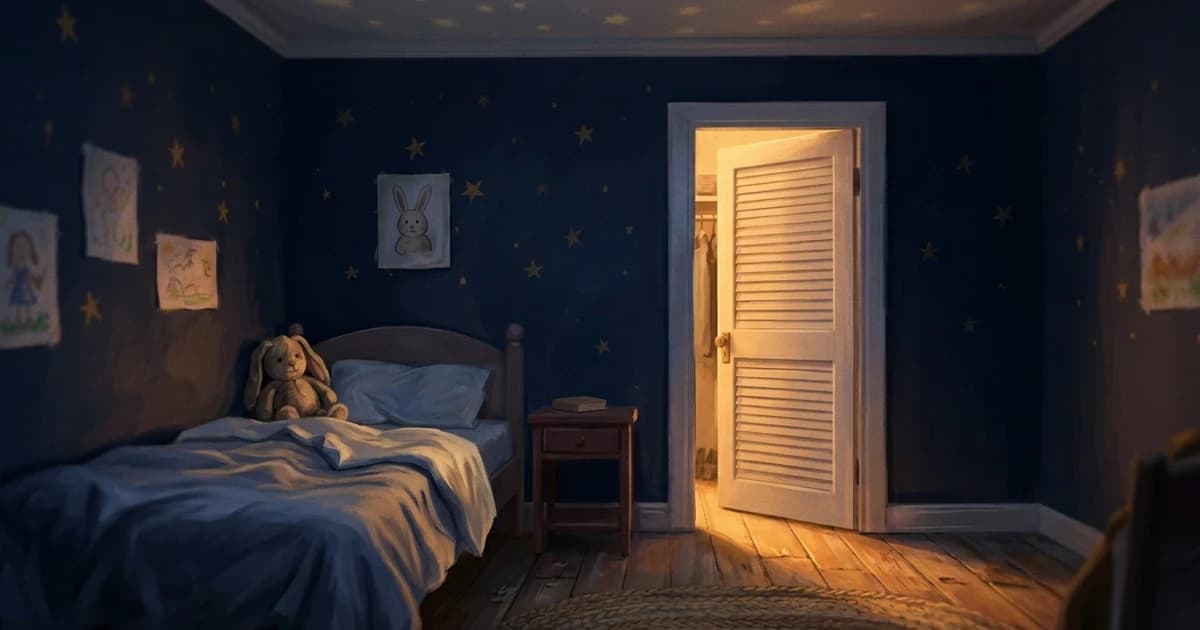
It's a Tuesday at 8:42 PM and your four-year-old has just whispered, with absolute conviction, that there is something in the closet.
You are tired. You are also two minutes from finishing the last load of laundry. The reasonable, evidence-based, parent-blog-approved answer is on the tip of your tongue: monsters aren't real, sweetheart. And you've said it. Twenty times. It has worked exactly zero of those times.
If anything, it backfires. They look at you with the steady, betrayed expression of someone who has been told the wrong answer to a question they did not actually ask.
Because they didn't ask whether monsters are real.
They asked whether the feeling — that thick, animal, body-level something is wrong — is real.
Why "monsters aren't real" backfires
Children between roughly three and seven are doing several developmental jobs at once that, taken together, make nighttime fears almost unavoidable.
Their imagination has just unlocked. They can now generate vivid mental images of things they have never seen. That same imagination doesn't yet come with a reliable off switch.
Their theory of mind is forming — they're starting to grasp that other agents might want things, including things that affect them. The closet, suddenly, contains the possibility of an agent.
And their prefrontal cortex, the part of the brain that helps say "wait, that's not realistic," is years away from finishing its wiring. The amygdala — older, faster, more confident — gets to vote first.
So when you say monsters aren't real, you are speaking to a part of the brain that isn't driving. The part that's driving has already noticed: the lights are off, the room sounds different, a parent is leaving, and the closet — that closet specifically — has not been investigated in the last several minutes.
A direct denial reads as: the grown-up does not understand the situation. Which is, on the inside, terrifying.
The shift that works: meet the feeling, then change the story
There is a body of clinical practice called narrative therapy — originally developed by Michael White and David Epston — built on a deceptively simple move: don't argue with the feeling, give the feeling a shape. Externalize it. Once a fear becomes a character, you can do something with it. You can name it. You can negotiate with it. You can, night after night, tell a story in which it gradually does something other than menace from the closet.
This is also why bibliotherapy — the structured use of stories in emotional work with children — has decades of research behind it. A story gives a child a metaphorical version of their own situation, far enough away that they can think about it, close enough that they can use it.
The five approaches below all lean on this idea. None of them require you to be a therapist. They require about four extra minutes at bedtime.
1. Externalize the fear into a small, manageable character
The night they tell you about the closet, don't dispute it. Say: "Oh. Let's find out who lives there."
Make up a character on the spot. The most useful version is small, shy, and slightly silly — not absent, not defeated. Something like a sleepy gray mouse who got lost from the field and is hiding in the closet because closets are quiet and dark and that is a mouse's idea of a perfect house.
You have just done three things:
- You took the unknown agent and made it small.
- You gave the fear a daily form — your child can now ask, at 8:42 PM, what's the mouse doing tonight?
- You created an ongoing story you can return to.
The fear hasn't gone away. It's now a recurring character in a story where your child has a relationship with it.
2. Use repetition — the same story, several nights in a row
Adults underestimate how much children need repetition. We assume that once a story has been told, it has done its work. The opposite is true. A child building emotional understanding around a difficult topic — fear, loss, change, a new sibling — needs the same story repeated, with small variations, across many nights.
This is not laziness. It is how the work happens. Each retelling lets the child rehearse the safe ending. Each variation lets them test the shape of the story from a slightly different angle.
So when you invent the closet mouse on Tuesday, tell that mouse's story again on Wednesday. And Thursday. Add a new detail each time — what the mouse ate, what the mouse dreamed about, how the mouse got brave enough to come out and look at the room.
After about a week, your child will be telling you what the mouse did. That is the goal.
3. Anchor the bedroom to a small sensory ritual
The dark is partly a sensory problem. It is the absence of the familiar daytime room. A small ritual that restores one sensory anchor gives the brain something to hold onto when the lights go off.
Options that work for most kids:
- A nightlight that projects a single moving image on the ceiling — a moon, stars, a slow blob of color. Not a busy lightshow. Something steady.
- A specific scent on the pillow — a few drops of lavender, the parent's worn t-shirt, the same plush animal washed in the same detergent.
- A short audio loop of soft sound — white noise, a quiet hum, a parent's voice telling a familiar story.
The point is consistency. The same sensory cue every night becomes a neurological "you are safe" signal. After about three weeks, the cue itself begins doing some of the work.
4. Tell stories where the dark is full, not empty
Most fear-of-the-dark stories try to convince children that the dark is empty — see, nothing there. This is a hard sell, because the dark is in fact full. Of imagined things, yes, but also of real things — sounds, shadows, breath, movement of the house.
A more honest, more useful framing: the dark is full of gentle things.
This is where the story content matters. Tonight's story can be about small animals that come out only after sunset because the day is too loud for them. About flowers that open at night. About the way owls talk softly to each other when they hunt. About a small character who discovers that the dark is not the absence of safety but a quieter form of it.
Once a child accepts that the dark has a content — and that the content is mostly peaceful — the closet becomes one more place where that content lives.
5. Anchor the bedtime story to a familiar voice
The single most consistent finding in attachment research, going back to Bowlby and Ainsworth in the 1950s and 60s, is that a child's nervous system regulates against the presence of a familiar caregiver. The sound of a parent's voice — at low volume, slow tempo, gentle prosody — is, neurologically, a regulator.
This is why a parent reading a bedtime story is more soothing than the same story played by a stranger, even a professionally-trained one. It's not the words. It's the voice.
When a parent has to be away — a work trip, a late shift, a separation — the absence of that voice at bedtime is felt. Recorded versions help: old voicemail, video calls, an audio note. Even better, when possible, is having tonight's bedtime story told in that voice — addressed to this particular child, about exactly the thing on their mind tonight.
This is the part of bedtime ParentWhisper was built for. A parent records their voice once. From then on, every personalized bedtime story — including the one about the small gray mouse in the closet — is told in that parent's voice. We started with the closet-mouse problem ourselves.
What not to do
A few patterns are worth naming because they are well-intentioned and they consistently make things worse:
- Don't search the closet to "prove" nothing is there. The act of searching confirms that searching is sometimes necessary, which installs the closet as a thing to be checked. The mouse-character approach reframes the closet as a neighborhood, not a threat.
- Don't sleep in the child's bed every time they ask. Once in a while is fine. Nightly drift toward co-sleeping is harder to reverse than the original fear and usually creates a separate problem.
- Don't promise the fear will be gone tomorrow. It might not be. Promise instead that tonight's story has a safe ending and you'll see the mouse again at the same time tomorrow.
What "fixed" looks like
Children don't usually announce that a fear has resolved. The signal is quieter than that. You'll notice, around night ten or eleven, that the child asks for "the mouse story" without first mentioning the closet. The closet has receded. The story remains. That is the work happening.
Most children move through fear-of-the-dark in three to six weeks of this kind of consistent narrative work. A few take longer; almost all get there.
If the fear persists for months, intensifies during the day, or shows up with other anxiety symptoms (refusing to leave the parent, stomach complaints, sleep disruption beyond bedtime itself), it's worth bringing to a pediatrician. Bedtime narrative work is a tool, not a substitute for assessment.
For everything that fits in that ordinary "she just got scared of the closet" range — which is most of it — the closet mouse is real, and the mouse is gentle, and that is the story for tonight.
Further reading
If you want the clinical roots of the externalize-the-problem move described above:
- White, M., & Epston, D. (1990). Narrative Means to Therapeutic Ends. W. W. Norton. The foundational text on narrative therapy; the chapter on externalizing conversations with children is where most modern parenting applications trace back to.
- Pardeck, J. T. (1995). Bibliotherapy: An innovative approach for helping children. Early Child Development and Care, 110(1), 83–88. A practical overview of how structured story use supports emotional development in young children.